

Description
The main component of Corrosion Probes is a metal sensing element. The element is destroyed after the probe is corroded by the medium in the environment in which it is used. Then its geometry changes. Using Ohm’s law, the resistance of a metal element is related to its geometric size. Finally, by measuring the resistance change of the element before and after corrosion. Combining the time monitoring of the two monitoring readings, we can calculate the corrosion rate (mm/a). Usually, the resolution of the resistance probe is one thousandth (1/1000) of the thickness of the probe-sensitive element. Depending on the selection of probes of specific thickness and sensitivity. The equipment can realize corrosion rate monitoring under different media.
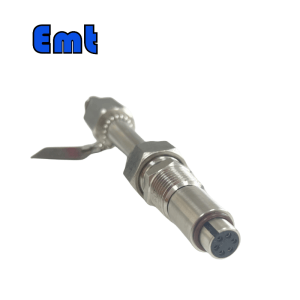
Name | EMT-CP High-Pressure Corrosion Probes For Pipeline Testing | |
| Material | Stainless Steel 316、L DUPLEX SS | |
| Operating Temperature | -20~200℃ | |
| Feature | Firstly, easy to Operating | |
| Secondly, high Accuracy Long Life | ||
| At last, high-Efficiency Low cost | ||
| Payment | TT/LC | |
| Advantage | Firstly, they are lightweight and flexible. | |
| And then nice Injection efficiency. | ||
| At last, accurate location tracking. |
ER probe metal sensing elements are available in a variety of geometries, thicknesses, and materials. For example, it includes shapes such as coils, tube coils, sheet coils, cylinders, spirals, flat heads, and sheets.
Resistance probes are suitable for a wide range of applications. It has almost all corrosive media environments. Including gas phase, liquid phase, solid phase, and flowing particulate media. The Corrosion Probes signal feedback time is short, and the measurement is fast. It can timely reflect the corrosion of equipment and pipelines. This keeps the internal corrosion of equipment and piping under constant surveillance. Therefore, for severely corroded parts, this method is an indispensable monitoring method.
Corrosion Probes

But due to instrument measurement resolution limitations. This makes the measured data more affected by changes in the corrosion rate of the process medium. Therefore, the measurement results sometimes have some deviation. For Corrosion Probes installed for the first time, it takes about 2 weeks to stabilize. Only then can it monitor reliable corrosion data. At the same time, the resistance probe method cannot measure the instantaneous corrosion rate. It is even less capable of monitoring localized corrosion rates. The smaller the thickness of the probe, the higher the sensitivity and the shorter the service life.
Generally, it is used in environments with extremely high precision requirements and relatively weak corrosiveness. When conductive substances (such as sulfide corrosion products) are attached to the surface of the component. It can lead to inaccurate measurements of corrosion rates. In drug evaluation, one cannot respond in a short time. Since the metal resistance is affected by temperature, the data of ordinary Corrosion Probes fluctuates greatly and is unstable due to the influence of temperature. Especially in areas with large temperature differences between morning and evening, such as oceans and desert areas, it is more obvious. Although temperature compensation samples were taken. However, the response of the compensation sample to temperature fluctuations lags behind that of the test sample. (especially rapid changes in temperature). This will also introduce errors in the measurement.
The Corrosion Probes monitoring system consists of a mount, a hollow cock, and a probe. Also extension rods, protective caps, data transmission lines, and data storage. It consists of a data collector and data processing software.
So if you have any other questions, please contact our professionals to answer them for you.

Ten major marine corrosion protection technologies
In the early stage of construction, attention should be paid to anti-corrosion methods. We maintain the machine through maintenance. This can minimize the overall cost during the durability period and ensure safety. This is an issue worthy of attention for major offshore engineering structures.
Anticorrosive coating (coating)
The coating is the primary means of corrosion control for ships and marine structures. Marine coatings include marine anticorrosive coatings and marine antifouling coatings. According to the anti-corrosion object material and corrosion mechanism. Marine anti-corrosion coatings include marine steel structure anti-corrosion coatings and nonsteel structure anti-corrosion coatings.

Antifouling coating
In the seawater immersion environment, marine fouling and biological attachment inevitably affect many facilities. So this causes biological contamination. Barnacles and other fouling organisms are attached to the hull. They can increase the navigation resistance by 15%. Fuel costs increased by 40% ~ 50%.
The antifouling coating is a special kind of marine coating. Its main purpose is to prevent marine organisms from attaching and contaminating marine structures. They can keep the bottom or ocean structure smooth and clean. Antifouling coatings are based on either low surface energy or self-polishing concepts. They all need to add a “toxin” — antifouling agent to the coating. There are many kinds of traditional antifouling coatings. Wherein the inorganic group comprises cuprous oxide. (there are also other copper compounds, such as cuprous thiocyanate).
And there is also mercury oxide. (although effective, it pollutes the environment and is banned). There is also zinc chloride (auxiliary antifouling agent) and so on. The organic class includes organotin compounds. (tributyltin TBT or triphenyl tin compound TPT, has been banned). And organic oxygen compounds. (DDT, has special effects on barnacles. But DDT is too stable, not easy to degrade, and pollutes the environment. It is banned all over the world.).
Corrosion-resistant material
Corrosion-resistant materials used in the sea include. Seawater corrosion resistant steel, corrosion resistant steel, dual-phase stainless steel, titanium alloy. Copper alloy, composite materials, polymer materials, high-performance concrete, etc. We also use metal and reinforced concrete.
Corrosion-resistant metal materials reduce the reaction rate of electrochemical corrosion by adjusting the conditions in the metal materials. Such as chemical element composition, microstructure, and properties of corrosion product film. Thus, the corrosion resistance of the metal material can be significantly improved.
Coating technology
The coating technology aims to effectively control the severe corrosion in the spray area. So it is based on the principle of isolating the corrosive medium from the material. Then they further improved the coating material. Now, this method has been applied on an industrial scale.
Surface treatment and surface modification
The modification also has another name surface treatment. It uses chemical and physical methods to change materials. Or changing the chemical composition or structure of the workpiece surface to improve the corrosion resistance of the parts. Chemical heat treatment (nitriding, carburizing, metalizing, etc.) Laser remelting and recombination, ion implantation, shot peening, Nanocrystallization and rolling composite metal commonly work in surface treatment methods. Firstly, the first three are to change the material composition of the surface layer. And then the middle two are to change the structure of the surface material. At last, the latter is to composite a layer of more corrosion-resistant material on the surface of the material.

Electrochemical protection
When the metal electrolyte dissolution corrosion system is subjected to cathodic polarization, the potential shifts negatively. Because the overpotential of metal anodic oxidation reaction decreases and the reaction speed decreases. So that the metal corrosion rate decreases. This is the cathodic protection effect. There are two kinds of electrochemical (cathodic) protection methods. Impressed current cathodic protection and sacrificial anode cathodic protection.
Corrosion inhibitor
The chemical substance with surface activity is first physically adsorbed on the metal surface. And then it converts them to chemisorption. This occupies the active sites on the metal surface. They thus serve to inhibit corrosion. There are several types of corrosion inhibitors. Inorganic corrosion inhibitor, organic corrosion inhibitor, compound corrosion inhibitor, other corrosion inhibitors, etc. Corrosion inhibitor often works in closed places. It includes oil wells and ships transporting oil and gas. Therefore, the corrosion inhibitor also has the combination with a scale inhibitor, bactericide, algaecide, cleaning agent, etc.
Structural health monitoring and testing
Whether it is the steel structure or the reinforcement in the concrete, monitoring and detection are the key means to grasping the corrosion state. Because it can perform early warning of the structure. It is also the basis of life evaluation. It thus ensures the safety of equipment and personnel. The monitored parameters mainly include corrosion potential, cathodic protection effect, the corrosion rate of the structure, fouling of marine organisms, coating condition, structural thickness change, hydrogen content in materials, environmental parameters, and other single and multi parameters. Parameter monitoring and intelligent real-time in-situ monitoring can realize the corrosion status analysis and life evaluation of the engineering structure the whole life. But the monitoring of marine corrosion monitoring/testing equipment and infrastructure in China is relatively weak.
At present, the means of marine corrosion monitoring are only relatively mature in the sea area above 200 m. At depths below 200 m. The corrosion judgment standard is not clear and the corrosion environment data is scarce. This will cause uncertainty in corrosion monitoring. The corrosion monitoring, corrosion coupon, and corrosion probe in offshore platforms and offshore oil and gas storage tanks are all foreign products.
Safety evaluation, reliability analysis, and life evaluation
It is a long-term task to ensure the safety and reliability of ships and offshore engineering structures. Due to severe corrosion. Therefore, whether the structure is safe and reliable in the service process needs to be evaluated. After the design life is reached, we consider the availability of the structure and the actual needs of the project. It is an important topic to carry out life evaluation and prolong life.
Protection differences between different materials
There are many material systems that work in ocean engineering. It includes steel materials and reinforced concrete structures. There are also non-ferrous metal materials and composite materials. (Aluminum alloy, titanium alloy, copper alloy, magnesium alloy, etc.) In terms of usage, steel and reinforced concrete are the largest. In terms of corrosion protection technology, the above-mentioned various protection technologies can be applied to different materials. However, there are differences between different materials and protection technologies. Lightweight characteristics of composite materials. These are expected to be further used in offshore engineering. Its protection technology needs to be further explored.

Our Service
Firstly, the fastest feedback!
Secondly, the fastest delivery time.
At last, 24 hours,7 days online.



Reviews
There are no reviews yet.